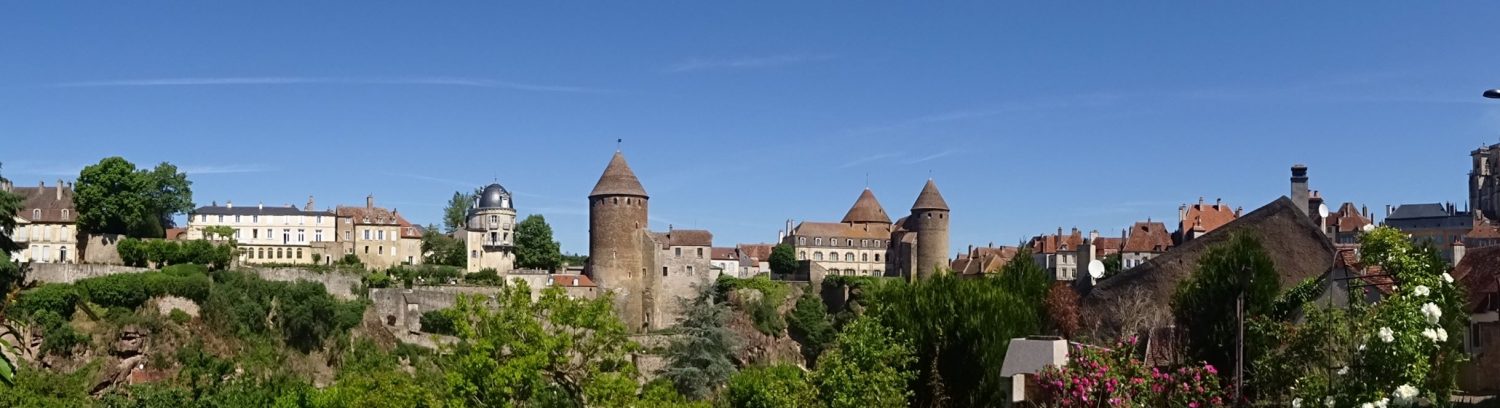

Nicolas Baudot était un notable important : le ressort de sa maréchaussée s’étendait au-delà de l’Auxois sur une partie du Châtillonnais. Désireux de faire construire une demeure digne de son rang, il avait obtenu de la municipalité de Semur la permission de l’édifier sur les courtines arasées de l’ancien donjon, site qu’il avait choisi dans l’espoir d’adjoindre la tour de l’Orle d’or à sa maison. Malheureusement pour lui, il s’avéra que non seulement cette tour mais l’ensemble de l’ancien donjon appartenait au roi et non à la ville. Il dut alors payer un cens annuel et perpétuel de 30 sols au domaine royal.
Il s’adressa pour son projet à son beau-frère, l’architecte Edme Verniquet (1727-1804). Celui-ci natif de Châtillon-sur-Seine, est l’auteur de plusieurs demeures et châteaux à Paris et en Bourgogne. Il est connu aussi pour avoir levé le premier plan exact de Paris en tant que commissaire général de la voirie de Paris. A Dijon, il avait rencontré Buffon qui lui offrit la possibilité de travailler à l’aménagement du Jardin royal des plantes médicinales (l’actuel Jardin des plantes, siège du Muséum national d’histoire naturelle). C’est lui qui agrandit le bâtiment abritant le cabinet du Roi, aménagea le labyrinthe avec son belvédère et commença la construction de l’amphithéâtre d’anatomie. A Semur pour son beau-frère l’architecte eut à intégrer la construction nouvelle à des bâtiments existants : à droite il ajouta un étage à une aile basse de la fin du 16ème ou début du 17ème siècle par-dessus l’ancienne charpente en carène de vaisseau renversé (qui existe toujours). Il dut modifier la charpente de la maison de gauche pour la rattacher au pavillon central. L’arrière du bâtiment côté rempart est traité sobrement, donnant l’impression de la réutilisation d’une tour carrée. La façade principale est d’une élégance toute néo-classique.
QR code : Former Hotel of the Provost of the Maréchaussée
Nicolas Baudot was an influential figure in his time. His Maréchaussée, (royal police court) extended its authority beyond the Auxois region into the Chatillonais. Aspiring to build a residence worthy of his status, he obtained permission from the town of Semur to construct his home on the levelled ramparts of the old keep. He even hoped to incorporate the adjacent Tour de l’Orle d’Or into his property. Unfortunately, the tower – and indeed the entire former keep – belonged to the King not to the town, forcing him to pay an annual rent of 30 sols to the royal domain.
To design his new residence, Baudot turned to his brother–in–law Edme Verniquet (1727-1804). Born in Chatillon sur Seine, Verniquet was renowned for his elegant townhouses and Chateaux both in Paris and Burgundy. He is best known for producing the first accurate plan of Paris, during his time as Commissaire Général de la Voirie, (Director of Public Works). In Dijon he renovated the Town Hall, and in Paris he worked on the Royal Garden of Medicinal Plants – today’s Jardin des Plantes, home to the National Museum of Natural History. There, he enlarged the King’s cabinet building, designed the famous labyrinth with its belvedere, and began work on the anatomical amphitheatre.
In Semur, Verniquet skilfully blended the new construction with the existing buildings. He added an extra storey above a 15th/16th century wing, crowned by a remarkable inverted ship’s hull roof structure, still visible today. To unify the ensemble, he adjusted the framework of the left-hand house to connect it to the central pavilion. The rear of the building, facing the ramparts, remains simple and restrained, evoking the former square tower that once stood there. The main façade meanwhile, displays a refined neo-classical elegance, a fitting reflection of its distinguished owner’s ambitions.